
Data-driven discovery of shared latent dynamics
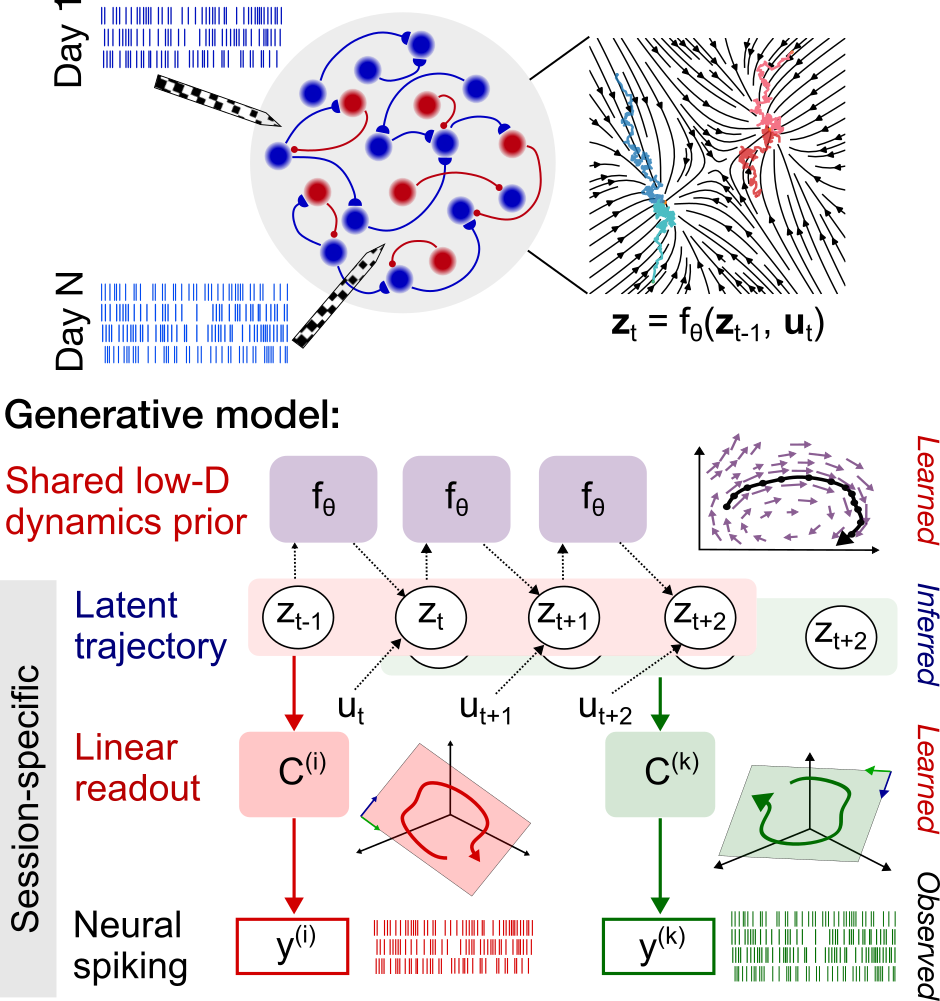 Reliably estimating and interpreting neural population dynamics in complex tasks, to link neural circuits to the behavioral computations they support, faces two crucial challenges: (1) balancing model flexibility with interpretability and reducing solution degeneracy, and (2) overcoming the limitations of short recording sessions and drift in chronic recordings, in tasks with heterogeneous trials and multi-dimensional behavioral variability, and where matching trials or neurons across days is challenging. We developed a method that learns a shared nonlinear, low-dimensional dynamical system across sessions that not only captures population co-variability through latent trajectories but learns correct dynamical solutions that enable forecasting. This allows combining or comparing trials across days in a shared latent space.
In collaboration with Christine Constantinople at NYU, we used this model to analyze recordings from orbitofrontal cortex (OFC) in rats performing a value-guided decision-making task. Joint optimization with a shared dynamical prior outperformed standard alignment methods, uncovering modulation of latent dynamics on single trials as well as across diverse conditions — time, belief states, stimuli, and decisions. Combining data across sessions allowed us to identify latent dynamics on different timescales: trial-by-trial updates of “belief states” during rare but diagnostic context switches, as well as changes in neural “speeds” during deliberation within individual trials controlling decision timing.
Our approach to dynamics-based alignment across sessions using a well-conditioned yet flexible model offers the opportunity to study richer behavioral variability and multiplexed computations in complex, or even more naturalistic, tasks, as well as track neural representations across days.