
Dynamical constraints on learning
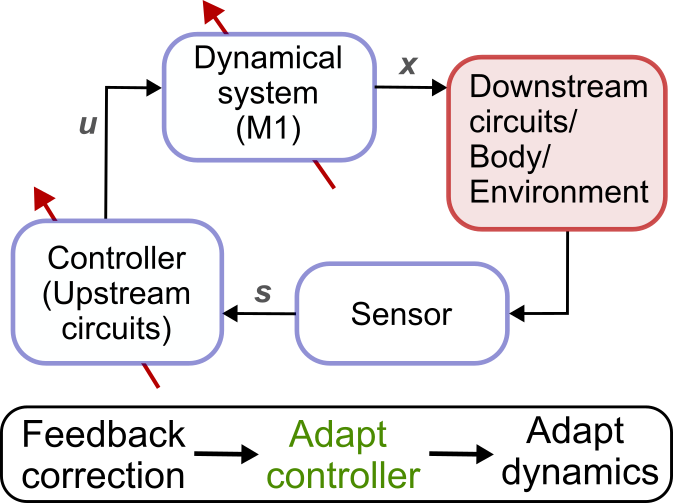 I use recurrent neural networks (RNNs) to model motor control tasks, including the use of motor BCI (brain-computer interfaces), where feedback about the output - either as “efference copy” and/or sensed state of the effector (limb, cursor, voice) - is a critical component to successful task completion. This feedback is needed to alter network dynamics in real time, in response to noise or external perturbations, to adjust the motor output. Moreover, learning in these networks may involve changes to the feedback inputs rather than to the recurrent network structure itself, especially when the dynamics are expressive enough. Borrowing insights from work on state-feedback controllers and modelling these “controllers” using neural network architectures, I study the implications of such an organization on observed neural activity structure and dynamical constraints on motor learning.
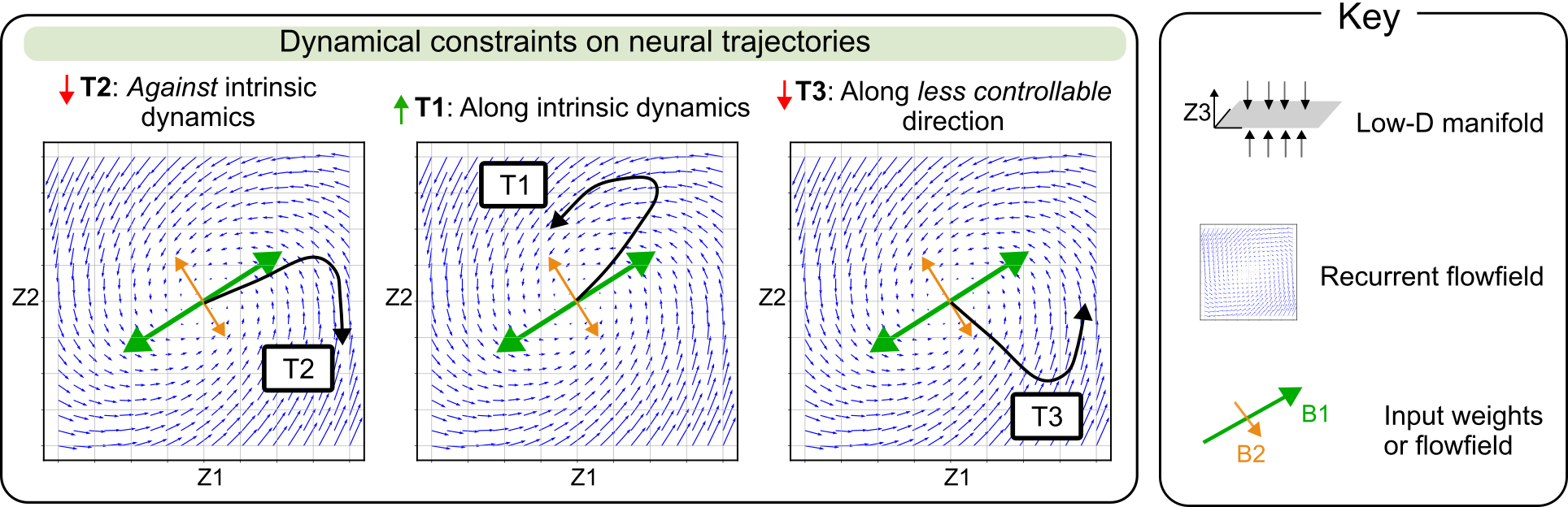 Previous work has shown that neural activity is often constrained to low-dimensional manifolds. We find that beyond neural geometry, structured dynamics on these manifolds further constrain learning on fast timescales. For motor circuits, these dynamics are shaped not just by internal recurrence but by low-dimensional control inputs based on continuous sensory feedback. By studying learning phenomena in a brain-computer interface (BCI) task and modelling plasticity at upstream controllers (such as cerebellar and premotor areas), we show that (i) feedback controllability, (ii) control bottlenecks, and (iii) input-driven flow-fields explain variable success and rates of adaptation to different BCI decoders, which we refer to as dynamical constraints on learning.