
Population dynamics in the cerebellar cortex
The cerebellum - an important locus for motor learning and sensorimotor coordination - interacts reciprocally with the neocortex via disynaptic pathways. Cortico-pontine inputs enter the first stage of cerebellar processing as mossy fibre (MF) terminals, where expansion recoding at granule cells (GrCs) is suggested to transform these inputs into more learnable and separable representations. However, granule cell activity is critically regulated by a small but powerful inhibitory network of Golgi cells (GoCs), which have been implicated in both homeostatic scaling and regulating GrC activity sparseness, dimensionality and spike timing.
During my PhD, I studied the spatiotemporal structure of GoC network activity, along with its relation to the feedforward mossy fibre inputs, to resolve how a small electrically-coupled network may perform such varied computational roles.
Dynamics of electrically-coupled cerebellar inhibitory networks
Two-photon imaging of Golgi cell network activity
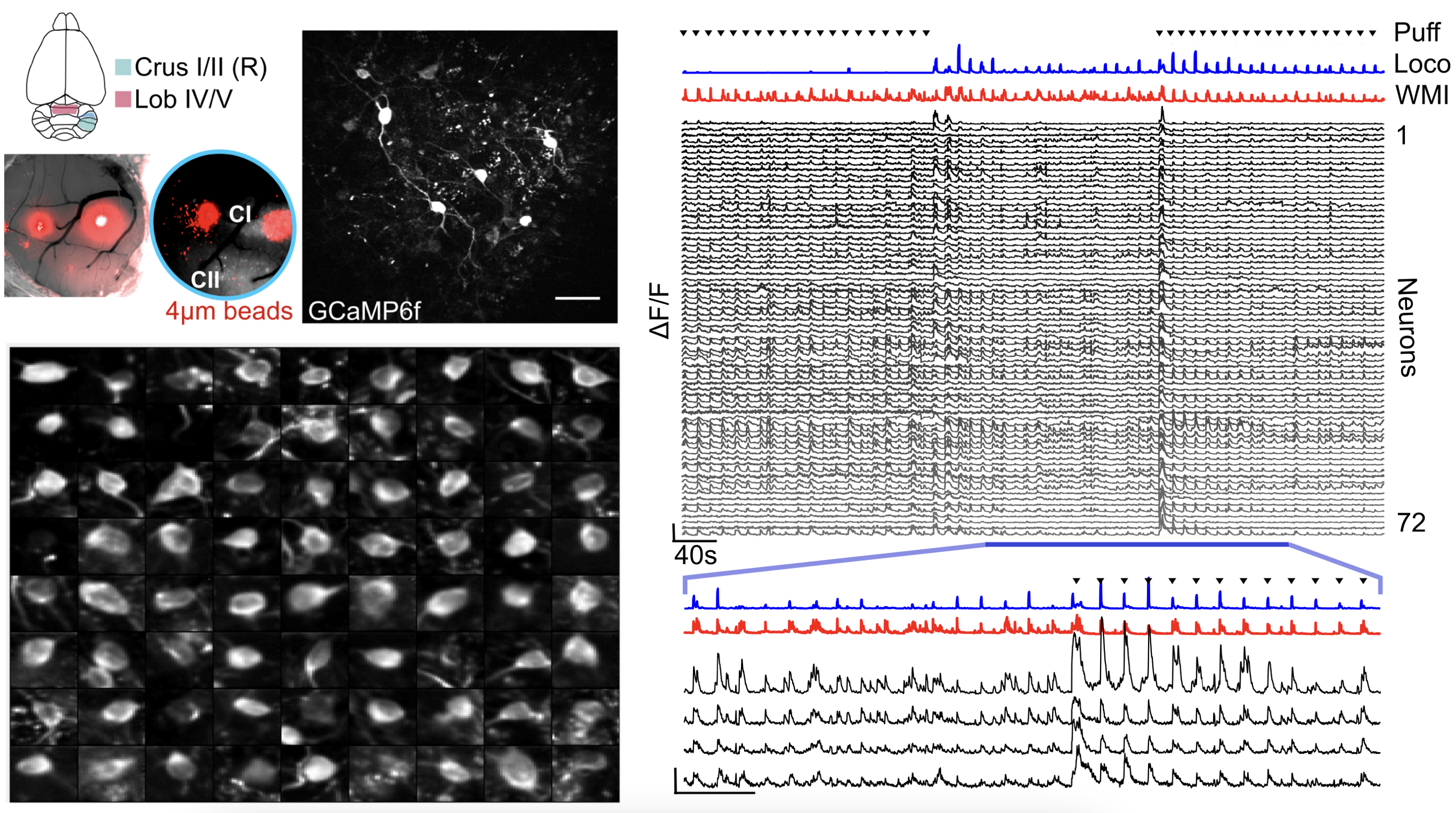 To examine the organisation of inhibitory population dynamics in the cerebellar granule cell layer, I used 3D random-access microscopy to monitor the activity of sparsely distributed Golgi cells. Using this approach, we desribed multidimensional GoC population activity, with both widespread and distributed components, that makes it well-suited for modulating the threshold and gain of downstream cerebellar granule cells and introducing spatiotemporal patterning.
Dynamical regime changes with electrical connectivity topology
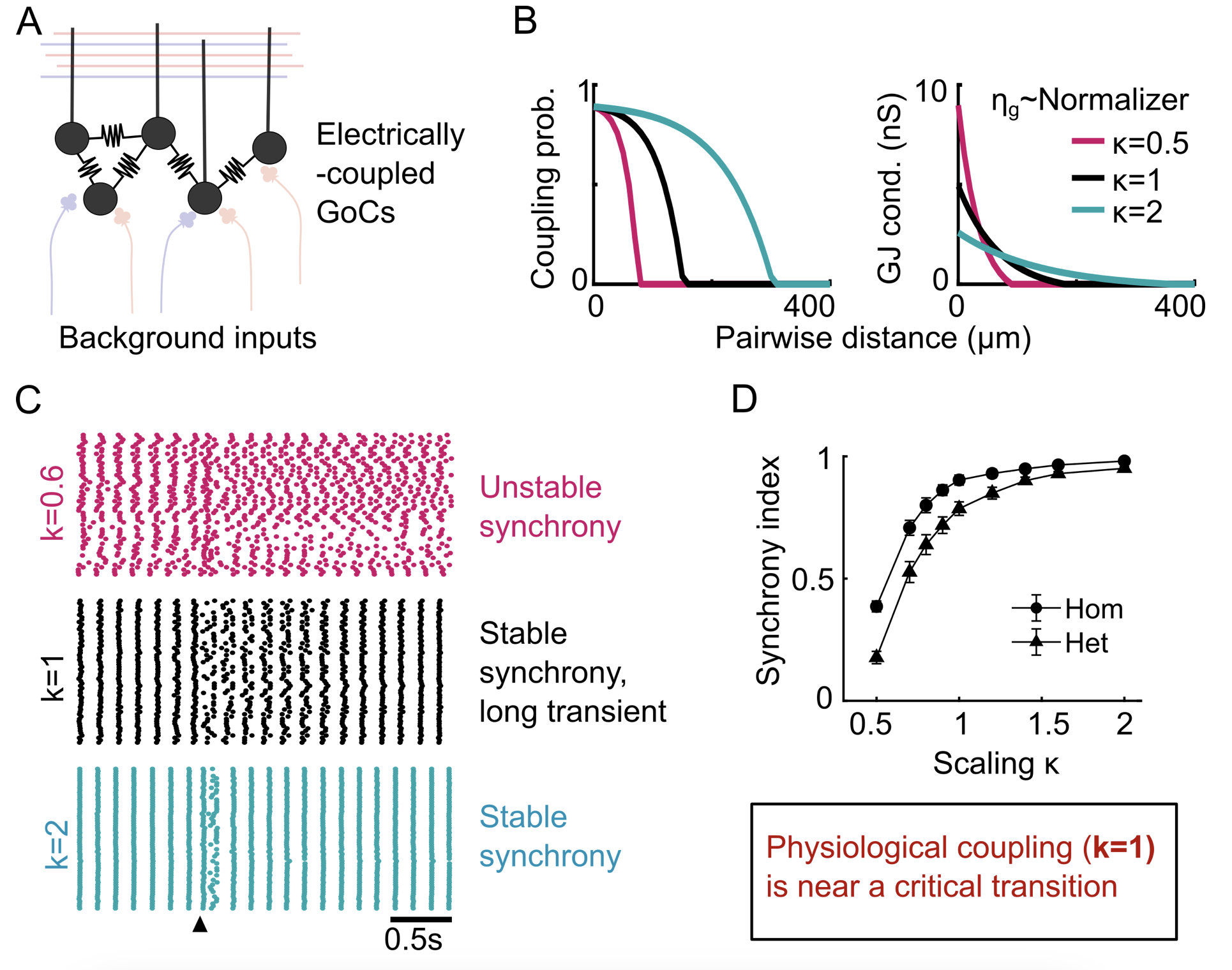 GoCs connect to each other via electrical synapses. We showed that network topology plays a role in determining the stability of synchronous spiking, as well as shaping slow dynamics. Moreover, experimentally-measured connectivity scale is close to a critical transition, resulting in long input-driven transients but ultimately stable synchrony. This allows us to posit new normative theories about the potential computational benefits of this dynamical regime.
Sensorimotor transformation across the cerebellar circuit
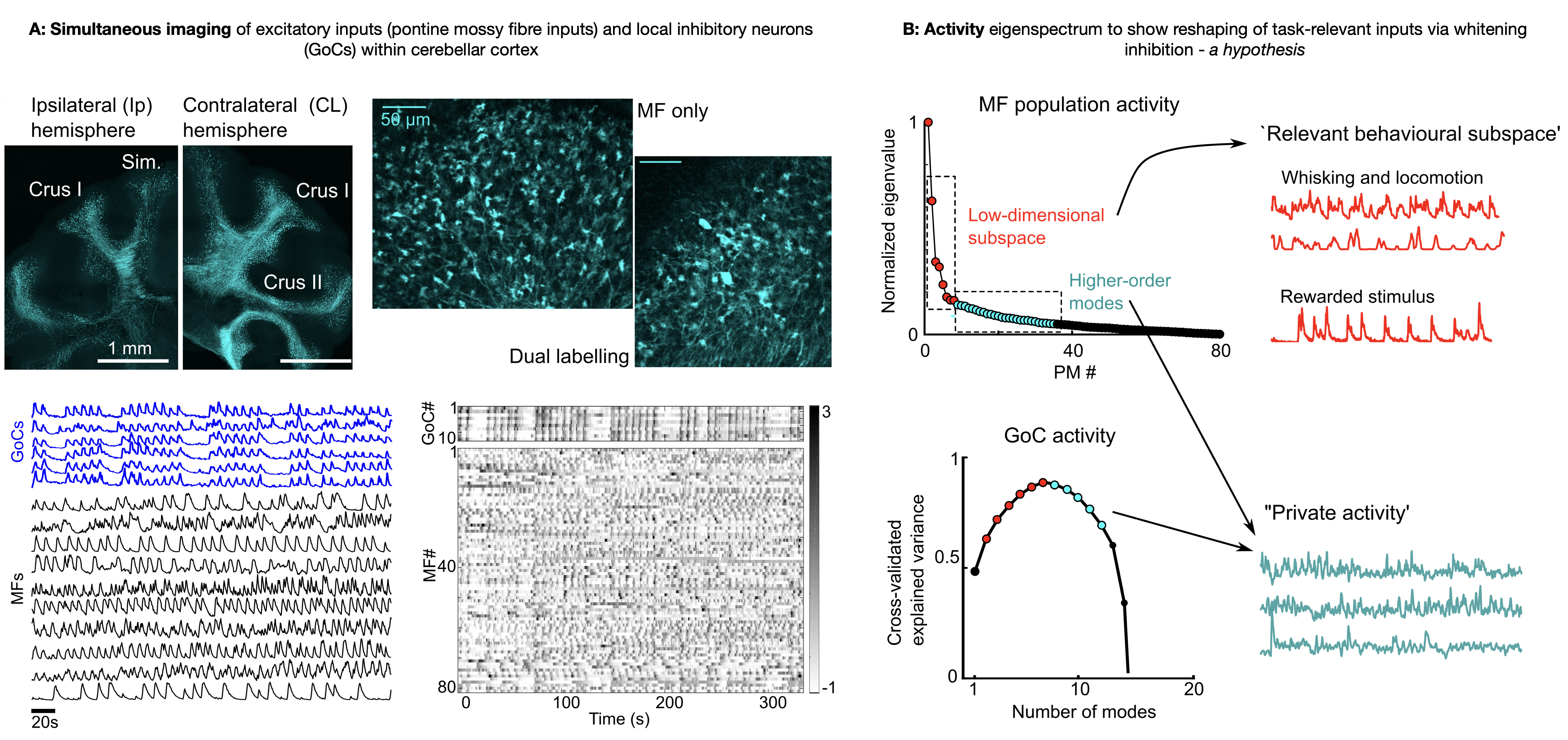 To further understand the role of structured inhibition in cerebellar computation, I used 3D random-access microscopy to monitor the activity of mossy fibre (MF) inputs simultaneously with GoCs in multiple paradigms - spontaneous behaviors, passive auditory stimuli, and throughout the acquisition of an auditory Go/No-Go task. By examining the plasticity of MF representations as well as how the relationship between inputs and GoC network activity changes during active behaviors, we test several theoretical predictions and provide a conceptual framework for the role of inhibition in shaping cerebellar cortical representations. Indeed, this adds to the growing consensus that even the primary stage of cerebellar processing shows task-specific adaptation and efficient representations, rather than a uniformly high-dimensional code.